
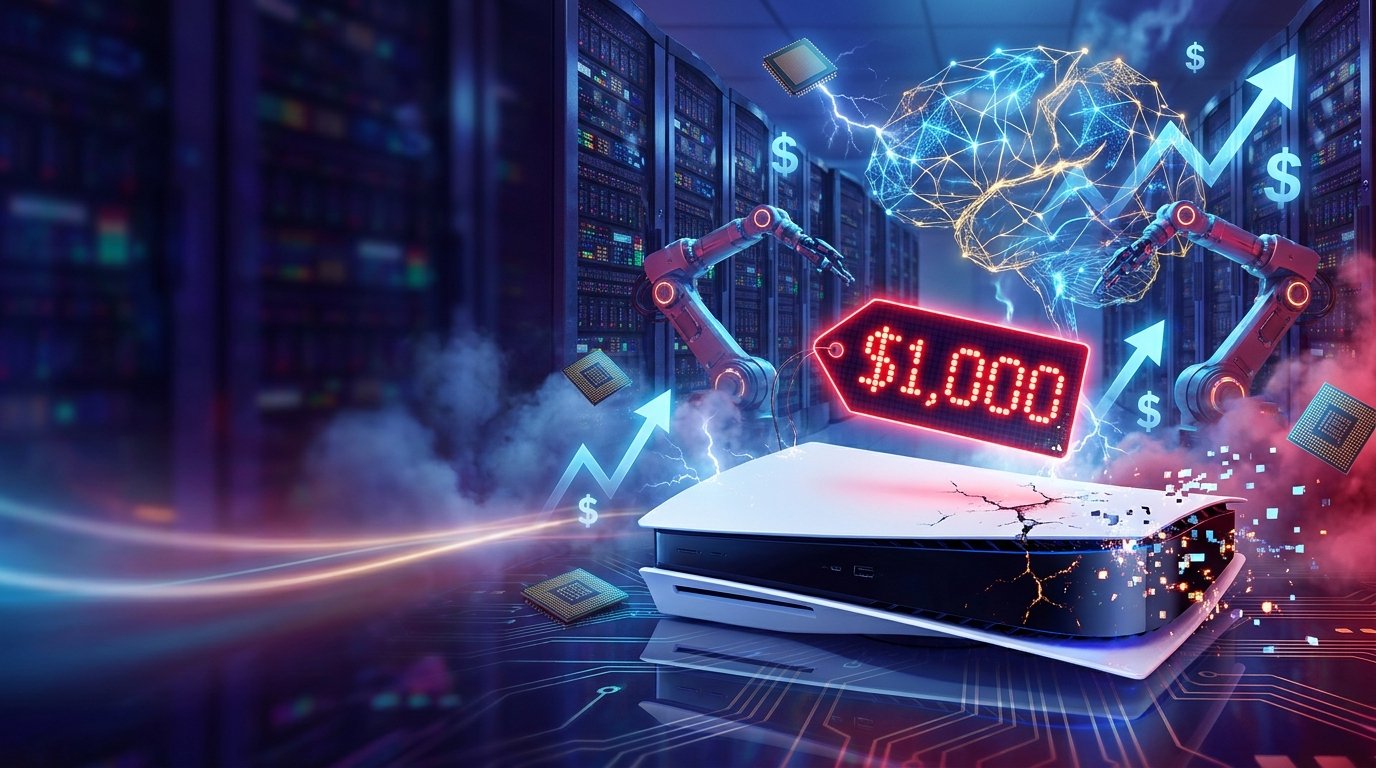
The gaming world is changing, and not in the way many of us hoped. For decades, the deal was simple: you buy a console for a few hundred dollars, you buy a disc, and you play. But that deal is breaking. If you’ve noticed that the PlayStation 5 is actually getting more expensive years after its launch, or that your favorite studios are being shut down, you aren’t alone.
There is a single “chain reaction” happening right now that is reshaping everything we know about video games. From the soaring cost of hardware to the death of physical discs, the culprit behind this shift is something you might use every day: Artificial Intelligence.
In this deep dive for The Gadget Net—your home for the latest tech news and honest reviews—we explore how the AI boom is effectively “swallowing” the gaming market and what that means for your wallet.
The Invisible War for Memory
To understand why a PlayStation 6 might cost as much as a used car, we have to look inside the box. Every gaming console needs RAM (memory) to run games smoothly. However, the same companies that make memory for consoles are now distracted by a much bigger, richer customer: AI companies.
The Math of Scarcity
A single high-end AI chip, like Nvidia’s Blackwell Ultra, requires 288 GB of specialized memory. That is the equivalent of 18 PlayStation 5 consoles’ worth of RAM in just one chip.
But AI companies don’t just buy one chip. They buy them in “racks.” One rack contains 72 AI chips, which equals the memory of 1,300 PS5s. When tech giants like Microsoft or OpenAI build data centers, they buy “clusters” of these racks. One cluster used by OpenAI recently represented 83,000 PS5s. Their upcoming “Stargate” project is expected to be 100 times larger than that—swallowing enough memory to fill almost every household in Australia.
Why Prices are Skyrocketing
Because big tech companies like Amazon, Google, and Meta are “galloping head-first” into the AI wars, they are willing to pay almost anything for memory. They aren’t even behaving like normal businesses; their fear of losing the AI race is bigger than their fear of debt.
This has created a “squeezed” market:
- 70% of the world’s memory output is now going into AI data centers.
- Memory prices for consoles have risen nearly 300% in a single three-month period.
- By 2027, the cost of console storage components is expected to be five times higher than it was just two years ago.
At The Gadget Net, we follow these trends closely to help you decide when it’s the right time to upgrade your tech. Unfortunately, the news right now is that the AI impact on gaming is making hardware a luxury rather than a staple.
Comparison: The Memory Gap
| Component | PlayStation 5 (Gaming) | Nvidia Blackwell Ultra (AI) |
|---|---|---|
| Memory (RAM) | 16 GB | 288 GB |
| Equivalent PS5s | 1 | 18 |
| Target User | Everyday Gamers | Big Tech Data Centers |
| Price Trend | Increasing ($399 to $599) | “Pay anything” status |
The Death of the $400 Console
For 30 years, the home console was the affordable way to game. It was the gift your parents could get you for Christmas without breaking the bank. But those days are fading.
The AI impact on gaming means that the clever GPU chip inside a graphics card is now often cheaper than the basic memory soldered around it. Because of these costs, rumors suggest the PlayStation 6 could launch at $1,000.
The “Melting Ice Cube” Problem
If a console costs $1,000, fewer people buy it. This creates a “death spiral” for the industry:
- Low Sales: Only a few million people buy the expensive new console.
- Developer Fear: Game developers see the small user base and decide to keep making games for the old console (like the PS5) because that’s where the 80 million customers are.
- No Reason to Upgrade: Since no “next-gen” exclusive games are coming out, players have even less reason to buy the $1,000 box.
The console market relies on “momentum.” If you don’t sell tens of millions of boxes right away, the platform dies—just like the Nintendo Wii U did.
How Companies are “Clawing Back” Money
Since the hardware is becoming too expensive to sell at a profit, companies like Sony and Xbox are looking for other ways to get your money. The AI impact on gaming is forcing them to pull four “levers” to survive.
1. The Death of Physical Discs
Sony has reportedly planned to stop shipping physical game discs entirely by 2028. By moving to digital-only, they kill the “second-hand” market. You can’t sell your old games on eBay or lend them to a friend. You have to buy them directly from the store at whatever price they set—even if a physical copy would have cost $5 at a local shop.
2. Subscription Price Hikes
Xbox and Nintendo have already started jacking up the costs of Game Pass and online services. When you can’t afford to own the hardware or the games, they want you to rent them forever.
3. In-Game Advertising
Imagine playing a game set in ancient Japan, only to see a billboard for car insurance. This isn’t a nightmare; it’s a plan. EA is currently building a platform to show real-time ads inside your games to make up for lost revenue.
4. Mass Layoffs
The industry is “squeezed and desperate.” Xbox has already fired thousands of people and closed five major studios. When memory costs more, companies cut human beings to balance the books. This means fewer creative, “risky” games and more safe remakes and sequels.
Pros and Cons of the AI Shift in Gaming
Pros
- Upscaling Tech: AI features like Nvidia’s DLSS can make games look better and run smoother on compatible hardware.
- Efficiency: AI might eventually help small teams build larger game worlds more quickly.
Cons
- Extreme Prices: Consoles and PCs are becoming luxury items.
- Loss of Ownership: The move to digital-only means you don’t truly “own” your games.
- Fewer New Ideas: Studios are sticking to “safe” sequels (like Fallout) rather than trying new things.
- Playtime Limits: Services like GeForce Now are already capping how many hours you can play per month.
The Future: Cloud, Mobile, and Nostalgia
If the traditional console model breaks, where will we go? The sources suggest three paths:
- Cloud Gaming: You rent a graphics card from Nvidia and stream the game. But as we’ve seen, this comes with “playtime caps” and monthly fees.
- The “Settle” Strategy: Many gamers are simply refusing to upgrade. 60% of PC enthusiasts say they won’t buy new hardware for at least two years, choosing to play older, classic games instead.
- The Mobile Takeover: Since everyone needs a smartphone for daily life, developers might stop making big console games and focus on mobile games filled with “battle passes” and “in-game currency”.
Final Thoughts
The AI impact on gaming is a reminder that we are in a unique moment in history. The richest companies on Earth are fighting a war for AI dominance, and the humble gaming console is caught in the crossfire.
As we continue to cover these changes at The Gadget Net, we encourage you to hold onto your physical discs and cherish your current hardware. The “golden age” of affordable, high-end home gaming is facing its toughest boss fight yet.
Frequently Asked Questions (FAQs)
1. Why is the PS5 getting more expensive? The cost of the memory (RAM) and components used to build consoles has skyrocketed because AI companies are buying up the global supply.
2. Will there be a PlayStation 6? Rumors suggest a PS6 is coming, but it may be delayed until 2028 and could cost significantly more than previous generations—potentially up to $1,000.
3. Is physical media really dying? Yes. Sony is expected to stop shipping discs by 2028, and even “physical” editions of games like GTA 6 or Elden Ring often only contain a download code rather than the actual game.
4. Can AI actually help gaming? While AI can help with graphics (upscaling), the hardware needed to run those features is also becoming more expensive and harder to find.
5. Should I switch to PC gaming instead? PC gaming is facing the same memory crisis. Graphics card prices are also being driven up by the high cost of VRAM, which now accounts for up to 80% of the total cost of some cards.

