
Have you ever looked up at the night sky and wondered what is happening way above the clouds? Most of us look down at our phones all day, but if you tilt your head up, you will see the fastest-growing market in human history. This is the Global Space Economy, and it is changing how we live, work, and invest.
For years, space was something only governments cared about. Today, it is a playground for innovators like Elon Musk and a goldmine for regular investors. At TheGadgetNet.com, we are dedicated to bringing you the latest updates on the tech that shapes our future. Whether it is the smartphone in your pocket or the satellite providing your internet, we cover the gadgets and systems that keep the world moving.
In this article, we will break down why the Global Space Economy is about to explode from a $630 billion market to a staggering $1.8 trillion by 2035.
The Layers of the Space Economy
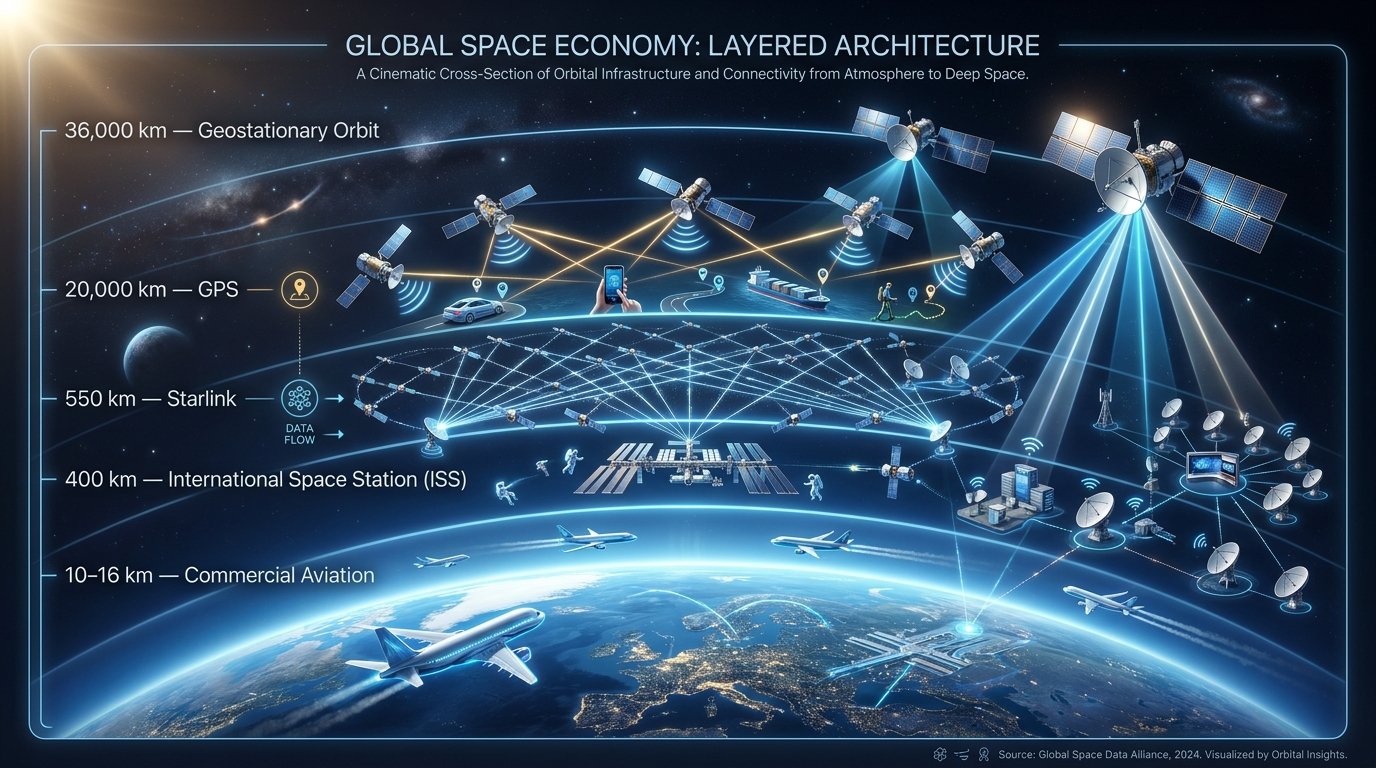
To understand the Global Space Economy, you have to understand where everything is. It isn’t just “up there”; it is organized in layers:
- 10 to 16 Kilometers: This is where commercial airplanes fly.
- 400 Kilometers: The International Space Station (ISS) lives here, where humans conduct research in zero gravity.
- 550 Kilometers: This is the home of Starlink satellites, which provide high-speed internet to the most remote corners of the Earth.
- 20,000 Kilometers: This layer holds the GPS satellites. Every time you order food or use a map on your phone, you are using this part of the space economy.
- 36,000 Kilometers: The Geostationary orbit. This is where TV satellites stay fixed so your dish at home never has to move.
Why Space Matters to Your Wallet
You might think space has nothing to do with your daily life, but a report from the UK suggests that if satellites went dark for just one hour, the entire global banking and economic system would collapse. Every bank transaction relies on the precise timing of satellite clocks.
The Global Space Economy is currently dominated by a few major players. The United States leads the way, accounting for 61% of global space investment. China follows at 12%, while India currently holds about 2%. However, India is planning a massive 450% increase in its space investment, aiming to reach $44 billion by 2040.
Comparison of Global Space Investment (2023)
| Country/Region | Market Share (%) | 2023 Investment (Estimated) |
|---|---|---|
| United States | 61% | ~$384 Billion |
| China | 12% | ~$75 Billion |
| India | 2% | $8 Billion |
| Others | 25% | ~$157 Billion |
The Rise of “Winvesting”: Space Stocks to Watch
The term “Winvest” (a mix of ‘Win’ and ‘Invest’ in space) is becoming a popular way to describe this new frontier. In the past year, many space-related stocks have seen incredible growth. For example, Rocket Lab has grown by 87%, and AST SpaceMobile has increased by 50%.
SpaceX, led by Elon Musk, is the undisputed leader. They currently own two-thirds of the 12,500 satellites orbiting the Earth. SpaceX has managed to lower the cost of sending cargo to space from $54,000 per kilogram to just $100 per kilogram using their new Starship. This massive price drop is what makes the Global Space Economy accessible to everyone.
Future Industries in the Stars
The Global Space Economy isn’t just about launching rockets. It includes many new businesses that will define the next decade:
- Space Data Centers: Elon Musk plans to put data centers in orbit where they can get constant solar power and won’t bother anyone with noise or heat.
- Debris Removal: There are currently 1.2 lakh (120,000) pieces of “space junk” orbiting Earth. Companies like LeoLabs are already tracking this debris to prevent collisions.
- Space Tourism: In the next few decades, going to space might be as common as taking a flight from New York to London.
- Asteroid Mining: Searching for rare minerals on small planets and asteroids.
Pros and Cons of Investing in Space
Pros
- Massive Growth Potential: The market is expected to nearly triple in the next 11 years.
- Monopoly Opportunities: Companies like SpaceX are creating massive leads that are hard to beat.
- Diversification: Adding space stocks can make your investment portfolio “well-diversified”.
Cons
- High Risk: Rockets can explode, and technology can fail in the harsh environment of space.
- High Regulation: Everything must be reported to the United Nations, and “space laws” are strictly followed.
- Long Timelines: Some projects, like Mars missions, may take decades to show a profit.
TheGadgetNet.com: Your Hub for Future Tech
At TheGadgetNet.com, we believe that staying informed is the best way to prepare for the future. We provide “write for us” opportunities for experts who want to share their knowledge on the Global Space Economy and other emerging technologies. If you are passionate about how satellites are changing 5G or how AI is managing space traffic, we want to hear from you!
How to Start Investing in Space
If you don’t want to pick individual stocks, you can look into ETFs (Exchange Traded Funds) like the UFO ETF. These funds hold a mix of different space companies, which reduces your risk while still giving you a piece of the Global Space Economy.
Frequently Asked Questions (FAQs)
What is the Global Space Economy?
It is the total value of all goods and services produced in space or for use in space, including satellites, rockets, and data services.
Is SpaceX a public stock?
No, SpaceX is currently a private company, though it has raised billions in funding and is valued at over $2 trillion.
What is “Space Junk”?
It refers to broken rocket parts and old satellites floating in orbit. Companies are now being formed specifically to clean up this debris.
How much will the space economy be worth?
Experts from the World Economic Forum and McKinsey predict it will reach $1.8 trillion by 2035.

