
Apple’s annual release cycle never sleeps, and the rumor mill for the next two generations is already spinning at full speed. If you are holding onto an older device or planning a strategic upgrade, understanding the Difference between Iphone 18 Vs Iphone 17 is critical for timing your purchase perfectly. The 2025 lineup promises a major design shakeup, while the 2026 models are rumored to introduce the first true architectural revolution since the original iPhone X. Consequently, the decision isn’t just about specs; it is about betting on the right innovation curve.
Key Takeaways
- Design Overhaul: The 17 series introduces a “slim” model and thinner bezels; the 18 series may pivot to a completely portless, foldable, or radical new form factor.
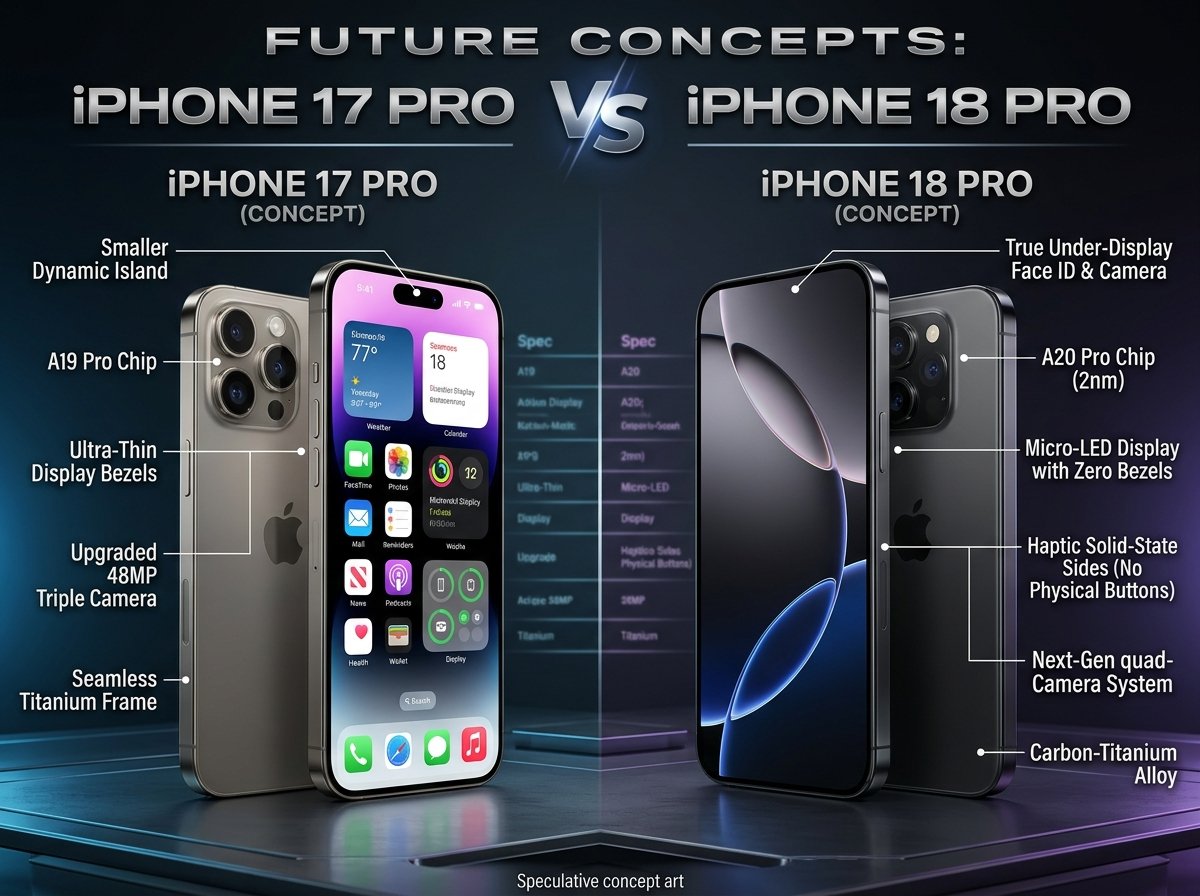
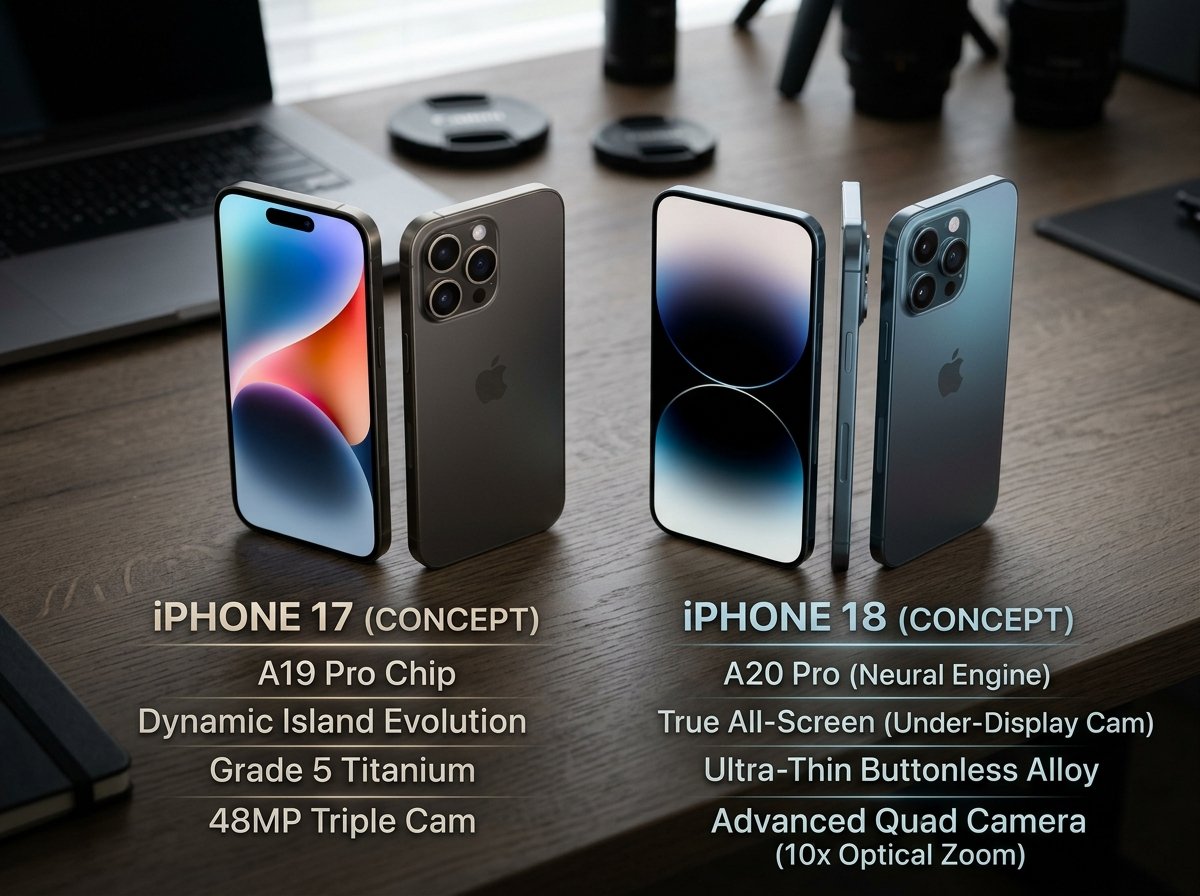
- Silicon Strategy: Expect the A19 chip (3nm) in the 17 lineup versus a potential 2nm A20 chip in the 18 series, marking a massive efficiency jump.
- Camera Evolution: Periscope lenses arrive on Pro Max 17; variable aperture and advanced computational video are targets for the 18 Pro models.
- Connectivity: Apple’s custom 5G modem debuts in the 17 series, maturing significantly by the 18 generation for satellite integration.
- Buying Advice: If you need a modern design now, the 17 series is the play. If you want the “next big thing,” wait for 18.
The 2025 Baseline: What the iPhone 17 Family Brings to the Table
Before we project forward, we must establish the foundation. The iPhone 17, 17 Air (or Slim), 17 Pro, and 17 Pro Max represent a pivotal “tick” in Apple’s tick-tock cycle. Furthermore, leaks suggest the standard 17 and 17 Air will finally adopt 120Hz ProMotion displays and LTPO technology, closing the gap with Pro models significantly. In addition, the Dynamic Island is expected to shrink across the board, thanks to advancements in Face ID component miniaturization.
The Pro models in 2025 are rumored to feature a titanium frame that is even lighter than the 15/16 series, alongside a 48MP Fusion camera upgrade for the ultra-wide lens. Therefore, the baseline for comparison is already incredibly high. When you Compare Iphone 18 and Iphone 17, you are not comparing a bad phone to a good one; you are comparing a refined masterpiece to a potential paradigm shift.
The “Air” Factor: A New Category in 2025
One of the biggest talking points for the 17 lineup is the replacement of the “Plus” model with a super-thin “Air” variant. This device prioritizes thinness and weight over battery capacity and thermal headroom. However, it creates a fascinating dilemma for the 2026 lineup. Will the iPhone 18 adopt this thinness as the new standard? Most analysts believe the 18 series will standardize the slim profile while solving the battery compromises found in the first-gen Air.
Silicon Showdown: A19 vs. A20 (The 2nm Leap)
Processing power is where the generational gap widens dramatically. The iPhone 17 series will almost certainly run on the A19 (standard) and A19 Pro (Pro models), fabricated on TSMC’s enhanced 3nm process (N3P). This brings solid performance-per-watt gains. However, the iPhone 18 series is widely tipped to be the launch vehicle for TSMC’s 2nm (N2) process node.
Consequently, the A20 chip could deliver a 15-20% performance uplift at the same power draw, or vastly superior battery life at current performance levels. Moreover, the Neural Engine architecture is expected to shift significantly in the 18 series to support on-device Apple Intelligence models that are too large for 2025 hardware. If you rely heavily on local AI processing, the 18 series is the strategic choice.
Camera Systems: Periscopes vs. Variable Aperture
iPhone 17 Pro Max: The Periscope Standard
For the 17 Pro Max, Apple is expected to bring the tetraprism 5x optical zoom (currently exclusive to the 15/16 Pro Max) to the smaller 17 Pro as well. The 17 Pro Max might push this further with a larger sensor behind the periscope for better low-light zoom. This makes the Compare Iphone 18 and Iphone 17 Pro Max discussion heavily focused on zoom versatility versus optical innovation.
iPhone 18 Pro: The Variable Aperture Rumor
Looking at 2026, credible supply chain whispers suggest the introduction of variable aperture on the main wide camera. This would allow the lens to physically stop down from f/1.4 to f/4.0 or smaller, providing true depth-of-field control and sharper landscapes without relying solely on computational simulation. In addition, 8K video recording at 60fps or higher is a strong candidate for the 18 Pro video specs, requiring the bandwidth of that 2nm ISP.
Design & Materials: Titanium, Glass, and the Portless Future
The 17 series continues the titanium era but with refined machining. The 18 series, however, is the subject of the wildest speculation. Multiple patents and analyst reports point toward a “portless” iPhone 18 Pro Max, relying entirely on MagSafe and Qi2 wireless charging with significantly faster speeds (potentially 30W+ wireless). Furthermore, there is persistent chatter about a foldable “iPhone 18 Fold” arriving alongside the standard slab models.
If the portless design materializes, water resistance ratings could hit IP69K, and internal space recovered from the Lightning/USB-C port allows for larger batteries or advanced thermal systems. However, this move would break CarPlay compatibility in older vehicles and require users to fully commit to the wireless ecosystem. The Difference between Iphone 18 and Iphone 17 Pro Max here is philosophical: iterative refinement versus ecosystem disruption.
Connectivity: The Apple Modem Maturation
The iPhone 17 marks the debut of Apple’s in-house 5G modem (codenamed Sinope). First-gen Apple silicon modems historically lag behind Qualcomm in mmWave support and power efficiency in fringe signal areas. By the iPhone 18 generation (2026), the second-gen Apple modem (Ganymede) should reach parity or superiority. Moreover, the 18 series is expected to integrate next-generation satellite connectivity directly into the modem die, enabling two-way messaging and potentially low-bandwidth data globally without a separate chip.
Display Technology: MicroLED on the Horizon?
While the 17 series sticks with Samsung/LG OLED (with thinner bezels via BRS technology), the 18 series has a non-zero chance of debuting MicroLED on the Ultra/Pro Max model. MicroLED offers infinite contrast without burn-in risk and significantly higher peak brightness. However, yield rates remain the bottleneck. If it doesn’t hit 2026, it is a lock for 2027.
Deep Dive: Compare Iphone 18 Pro Vs Iphone 17 Pro
For the “Pro” user, the comparison is the most nuanced. The 17 Pro offers a known quantity: a 6.3-inch display, 3nm chip, 5x zoom, and USB-C 3.2 speeds. The 18 Pro counters with a 2nm chip, potential variable aperture, a likely larger 6.4-inch display (bezels shrinking further), and the wildcard of a portless chassis. Additionally, RAM is expected to jump to 12GB standard on the 18 Pro (up from 8GB on 17 Pro) to handle larger on-device LLMs.
If your workflow involves heavy video editing, 3D scanning, or local AI inference, the 18 Pro’s thermal envelope and memory bandwidth will be transformative. Conversely, the 17 Pro represents the “last of the great ports” era, offering maximum compatibility with existing pro accessories like wired SSDs and capture cards.
Deep Dive: Difference between Iphone 18 and Iphone 17 Pro
Comparing the base model 18 against the 17 Pro is a classic “new base vs old pro” dilemma. Historically, the base model inherits the previous year’s Pro chip (A19 in 17 Pro -> A19 in base 18?). However, with the 2nm jump, the base iPhone 18 might get the A20, leapfrogging the 17 Pro’s A19 Pro in raw efficiency. The 17 Pro retains the hardware advantages: telephoto lens, 120Hz ProMotion, and premium materials. The base 18 counters with a modern design language, newer modem, and longer software support window (one extra year of iOS updates).
Software & Intelligence: The Apple Intelligence Divide
Apple Intelligence is the new battleground. The 17 series will launch with iOS 19, supporting the current wave of features. The 18 series launches with iOS 20, likely introducing “Apple Intelligence 2.0” with significantly larger on-device models requiring the 2nm Neural Engine. Consequently, the 18 series will enjoy a longer “premium” support lifecycle for AI features. The 17 series will get updates, but heavy on-device tasks may offload to Private Cloud Compute more frequently, introducing latency.
Pricing & Value Proposition
Pricing is the ultimate decider. The 17 series pricing structure is relatively predictable: $799/$899/$999/$1199. The 18 series introduces pricing chaos. A foldable model could start at $1,799. A portless Pro Max might command a $100 premium for the advanced wireless charging hardware. If you buy a 17 Pro Max at launch, you get peak resale value retention for a “port” device. If you wait for 18, you pay the “early adopter tax” on new form factors.
Which Generation Should You Actually Buy?
Buy the iPhone 17 series if: Your current phone is broken, you need USB-C wired connectivity for work, you want the new “Air” design, or you prefer a mature modem implementation. The 17 lineup is the “safe,” refined peak of the current design language.
Wait for the iPhone 18 series if: You can hold your current device another year, you are fascinated by foldables or portless designs, you need maximum on-device AI performance, or you want the 2nm efficiency leap for 25%+ better battery life. The 18 series is the “risk/reward” play for the next decade of iPhone design.
Frequently Asked Questions
Will the iPhone 18 actually be portless?
Strong rumors from Ming-Chi Kuo and supply chain sources suggest a portless “iPhone 18 Pro Max” or “Ultra” is in advanced development for 2026. However, Apple often tests radical designs internally that never ship. The standard iPhone 18 and 18 Pro will likely retain USB-C. The portless model would rely on next-gen MagSafe (Qi2.1) hitting 30W+ speeds to compensate.
Is the iPhone 17 “Air” worth waiting for over the iPhone 16?
If you value thinness and weight above all else, yes. The 17 Air is rumored to be ~5.5mm thick with a 6.6-inch display. However, it reportedly sacrifices the telephoto lens, uses a single speaker, and has a smaller battery. The standard iPhone 17 gets 120Hz and the A19 chip, making it a better value proposition for most users compared to the niche Air model.
How big is the performance gap between A19 (3nm) and A20 (2nm)?
Historically, a full node shrink (3nm to 2nm) delivers ~15% speed gain at same power, or ~30% power reduction at same speed. For the iPhone 18, this translates to either a noticeably snappier UI under heavy load or an extra 2-3 hours of screen-on time. The bigger win is transistor density, allowing a much larger Neural Engine for AI.
Will the iPhone 17 Pro get the same 5x zoom as the Pro Max?
Yes, current leaks strongly indicate the tetraprism 5x optical zoom module is shrinking enough to fit inside the smaller 6.3-inch 17 Pro chassis. This eliminates the camera disparity between the two Pro models that existed in the 15 and 16 generations, making the 17 Pro significantly more attractive.
Should I skip the 17 series entirely and wait for the 18?
Only if your current phone (iPhone 13 Pro or newer) is functioning well. The 17 series brings 120Hz to base models, a new modem, and a fresh design. That is a tangible daily upgrade. The 18 series offers potential paradigm shifts (foldable, portless, 2nm) that carry first-gen risks. If you upgrade every 3-4 years, the 17 is the smarter financial move; if you upgrade every 5+, wait for 18.
Ready for the Future of iPhone?
The leap from 17 to 18 isn’t just iterative—it’s potentially historic. Whether you buy in 2025 or wait for 2026, stay ahead of the curve.

