
1. Introduction and Expected Launch Timeline
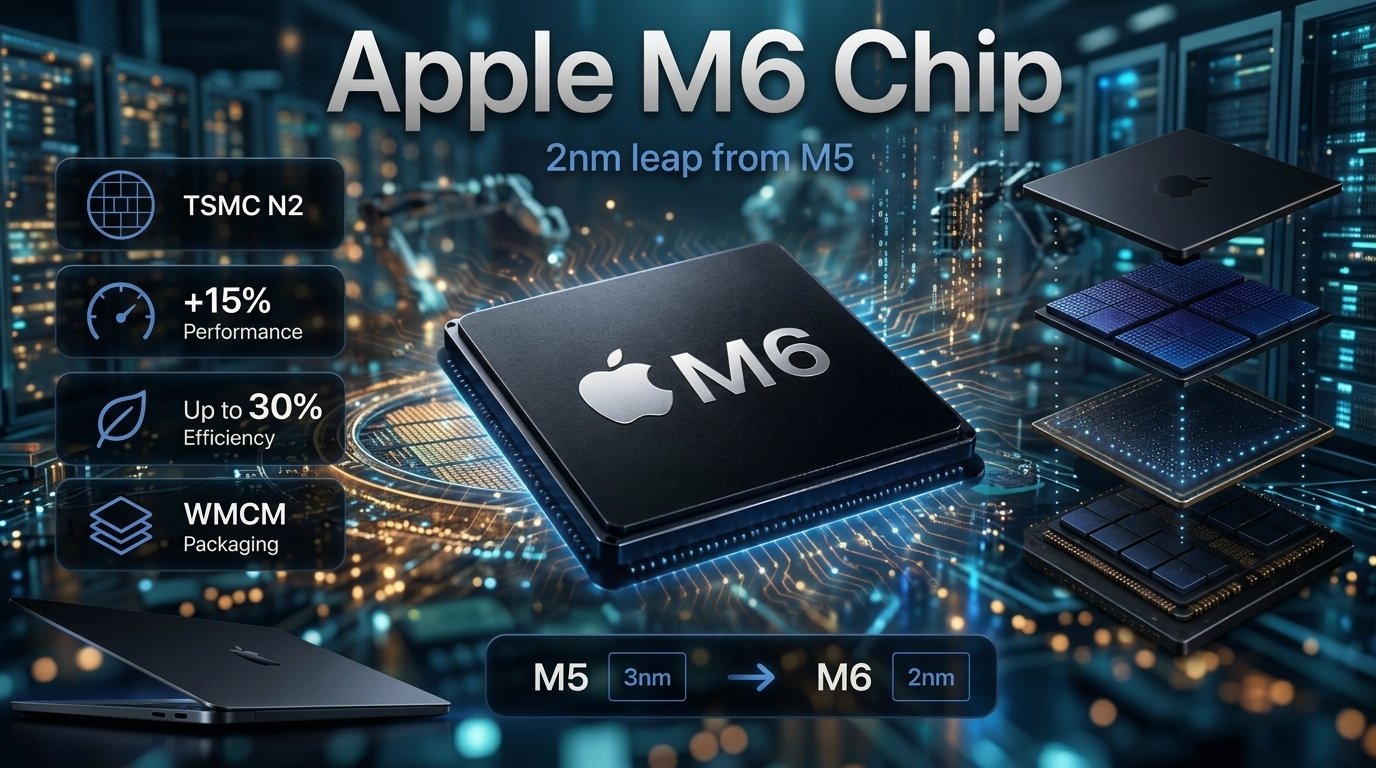
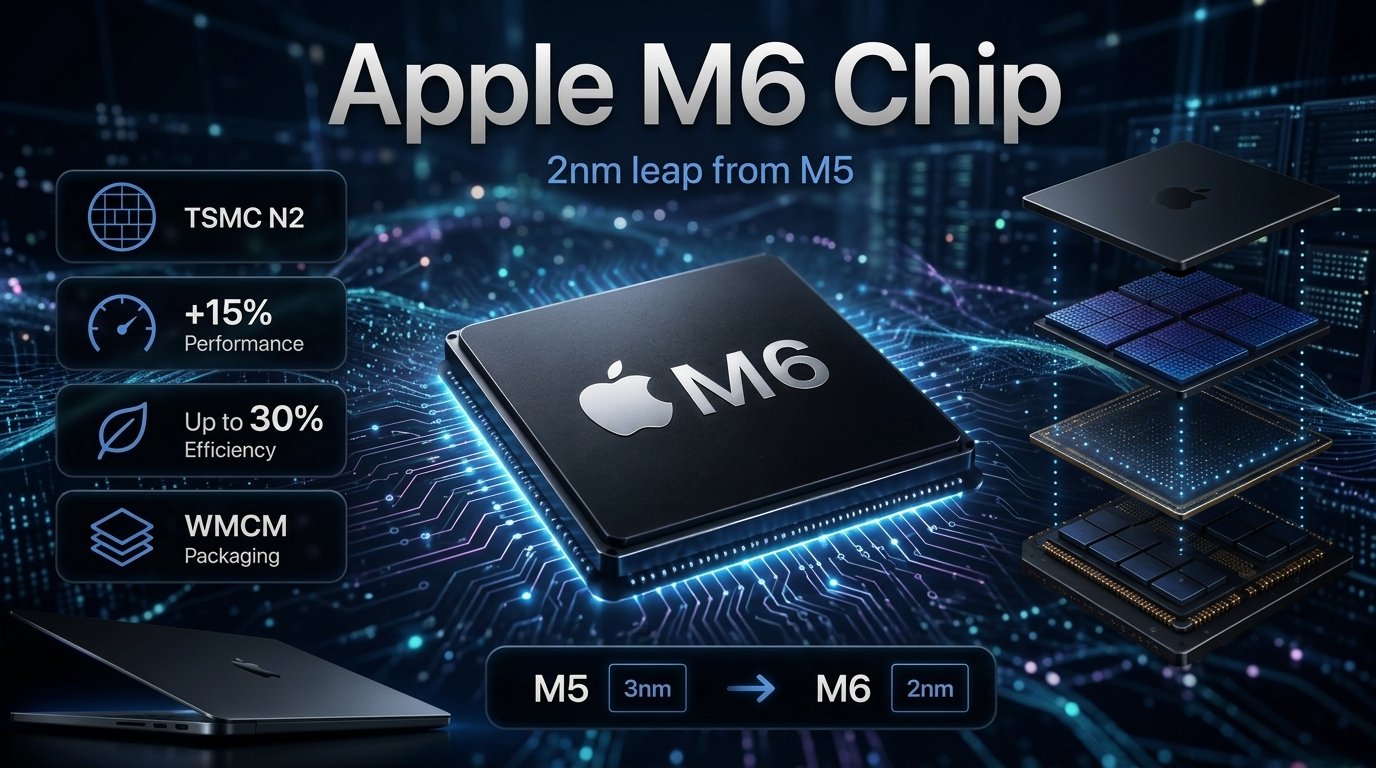
Apple is preparing an aggressive internal overhaul for its entry-level professional laptop line with the upcoming macbook pro 14 inch m6. Engineered around TSMC’s cutting-edge 2-nanometer (2nm) manufacturing process, a novel three-tier CPU architecture, and a dual-engine artificial intelligence setup, the new baseline model represents a major architectural shift for Apple’s portable silicon portfolio.
According to reports from Bloomberg’s Mark Gurman, Apple has finalized plans for an online product unveiling on October 27th. This digital announcement will be followed immediately by exclusive, in-person media briefings scheduled in Los Angeles on October 28th.
Key Takeaways: Launch Schedule & Strategy
- Online Product Unveiling: October 27th
- Exclusive Media Briefings: October 28th (Los Angeles)
- Market Strategy: Lock down the premium portable segment ahead of the crucial November holiday shopping rush.
- Staggered Rollout Playbook: Follows the August 25th desktop debut of the base M6 silicon inside the refreshed Mac Mini desktop.
This release strategy directly mirrors the deployment playbook Apple executed in 2024, when the base M4 chip debuted inside the iPad Pro in May before arriving in the 14-inch MacBook Pro in late October. In 2026, Apple initiated its M6 rollout on August 25th by introducing the base M6 silicon alongside the workstation-class M5 Ultra inside a refreshed 5×5-inch Mac Mini desktop. Bringing this desktop-verified silicon to the 14-inch MacBook Pro allows Apple to secure the portable market ahead of the November holiday shopping rush, even as industry rumors circulate regarding a more expensive, next-generation OLED touchscreen MacBook Pro positioned further down the product roadmap.
2. Silicon Foundation: TSMC 2nm Node and Core Architecture Overview
The M6 chip marks Apple’s official transition to TSMC’s flagship 2-nanometer manufacturing process node. Shrinking the lithography down to 2nm allows chip designers to pack significantly higher transistor density into a smaller physical footprint, unlocking higher computational efficiency and greater overall throughput.
In its baseline configuration, the M6 processor scales up core counts and memory bandwidth over the previous entry-level generation, stepping up from the 10-core CPU and 10-core GPU baseline found on the M5.
| Architectural Feature | Baseline M6 Configuration (vs. Base M5 Generation) |
| Manufacturing Process Node | TSMC 2nm Process Node (Generational leap from prior sub-nodes) |
| CPU Core Layout | 12 Cores (Tri-Cluster Architecture vs. 10 Cores on Base M5) |
| GPU Core Count | 12 Cores (Hardware Ray Tracing & Dynamic Caching vs. 10 Cores on Base M5) |
| Unified Memory Bandwidth | Up to 170 GB/s (Expanded memory pipeline for high-throughput workloads) |
| Neural Engine Hardware | Dual 16-Core Engines (32 Cores Total vs. Single 16-Core Engine on Base M5) |
3. Breakthrough CPU Redesign: The 12-Core Tri-Cluster Architecture
For the first time in the history of Apple Silicon, a base-tier M-series processor splits its CPU across three distinct core types rather than two. Historically, complex CPU tiering—combining dedicated high-frequency super cores alongside separate performance clusters—was strictly reserved for higher-tier hardware configurations like the M5 Pro, M5 Max, and M5 Ultra.
M6 CPU Tri-Cluster Layout at a Glance
- Super Cores (2 Cores @ 4.8 GHz Peak): Ultra-high frequency single-threaded execution engine.
- Performance Cores (4 Cores @ 4.5 GHz Sustained): Heavy multi-threaded throughput cluster.
- Efficiency Cores (6 Cores @ 2.9 GHz): Low-power background process management.
The M6 tri-cluster architecture distributes workloads across twelve specialized cores:
- Super Cores (2 Cores at 4.8 GHz Peak): Engineered to deliver unthrottled single-threaded speeds. These high-frequency cores handle instantaneous system responses, application launching, OS interface interactions, and complex web scripts without latency.
- Performance Cores (4 Cores at 4.5 GHz Sustained): Built for continuous, heavy multi-threaded workloads. These cores manage demanding computational tasks such as compiling code packages, rendering 4K video streams, and executing complex multi-application workflows.
- Efficiency Cores (6 Cores at 2.9 GHz): Dedicated to managing lower-level background operating system tasks, maintaining baseline system responsiveness while minimizing power draw during idle or lightweight operations.
4. Graphics Engine and On-Device AI Acceleration
The graphics pipeline in the baseline M6 features a 12-core GPU equipped with hardware-accelerated ray tracing, dynamic caching, and up to 50% faster geometry rendering rates compared to the previous generation. However, the most substantial hardware overhaul occurs within the silicon’s artificial intelligence acceleration blocks.
Dual Neural Engine Architecture and GPU Accelerators
Across all previous generations—from the original M1 through the base M5—Apple integrated a single 16-core Neural Engine on the entry-level die. The M6 places two separate 16-core Neural Engines side-by-side on the silicon wafer, doubling peak compute performance for complex AI tasks over the M5. Furthermore, Apple integrated a dedicated neural accelerator hardware block inside each of the 12 GPU cores, boosting peak GPU-assisted AI compute by nearly 30%.
AI Hardware & Benchmark Metrics
- Dedicated AI Silicon: Dual 16-Core Neural Engines (32 Cores Total)
- GPU AI Enhancement: Dedicated neural accelerator block per GPU core (+30% peak compute)
- Local 9B Parameter LLM Execution:
- Base M4 Generation: 210 tokens per second
- Baseline M6 Generation: 742 tokens per second
- Framework Support: macOS 27 core developer frameworks for concurrent dual-engine execution
 Real-World AI Applications
With macOS 27 introducing deeper system-wide artificial intelligence integration, updated core developer frameworks allow native applications to tap into both 16-core Neural Engines simultaneously. This enables:
- Local LLM Execution: Running 9B+ parameter language models locally on-device without cloud latency or subscription fees.
- Xcode Intelligence: Real-time syntax indexing and project-wide code generation for software engineers.
- Media & Spatial Processing: Instant spatial object tracking and automated background isolation inside professional video editing suites.
Independent benchmarks conducted on the shipping M6 Mac Mini verify these performance claims: when processing prompts on a local 9 billion parameter language model, execution speed jumped from 210 tokens per second on the M4 to an impressive 742 tokens per second on the M6.
5. Thermal Realities and Real-World Power Draw Considerations
While on-paper specifications show substantial architectural gains, physical form factor constraints introduce critical real-world performance trade-offs for mobile users.
Single-Fan Cooling Limits and Super Core Frequency Bursts
The upcoming 14-inch MacBook Pro retains its familiar aluminum chassis fitted with a single thermal cooling fan setup. While driving two Super Cores at a blistering 4.8 GHz alongside four Performance Cores at 4.5 GHz looks impressive in short benchmark bursts, single-fan thermal dissipation faces steep physical limits under sustained workloads.
Although TSMC’s 2nm process node improves energy efficiency per transistor, pushing high-frequency CPU cores and 12 GPU cores simultaneously generates intense localized thermal density. As demonstrated by historical sustained rendering tests on the single-fan base M3 14-inch MacBook Pro, single-fan enclosures are forced into rapid fan spin-up and aggressive thermal throttling during continuous multi-threaded rendering loops compared to the dual-fan cooling systems inside higher-end Pro and Max chassis.
Desktop Power Draw Curves vs. Mobile Battery Workflows
Translating desktop-verified efficiency gains to a portable, battery-dependent workflow requires realistic expectations. While the desktop M6 Mac Mini draws continuous wall power without energy budgets, mobile users operating on battery power face a distinct power draw curve. Pushing two Super Cores at 4.8 GHz peak frequencies while running dual 16-core Neural Engines and GPU neural accelerators simultaneously creates sharp power draw spikes under load. Prospective buyers expecting extended battery life during continuous, heavy multi-threaded local AI prompting or 4K rendering will see faster battery depletion when forcing the silicon into its peak boost states.
6. Conclusion and Summary
The 14-inch MacBook Pro powered by the M6 chip delivers desktop-verified 2nm architecture, a 12-core tri-cluster CPU design, and unprecedented local AI hardware performance into a portable form factor. With an official digital announcement slated for October 27th and media briefings on October 28th, Apple is positioning this machine to establish a new benchmark for entry-level professional laptops ahead of the holiday season.
At a Glance:
- Launch Timeline: October 27th online product unveiling; October 28th Los Angeles media briefings.
- Silicon Node: Built on TSMC’s cutting-edge 2nm manufacturing process.
- CPU Architecture: 12-core tri-cluster layout (2 Super Cores @ 4.8 GHz peak, 4 Performance Cores @ 4.5 GHz sustained, 6 Efficiency Cores @ 2.9 GHz).
- GPU & Memory: 12-core GPU with hardware ray tracing, dynamic caching, 50% faster geometry rendering, and up to 170 GB/s unified memory bandwidth.
- AI Engine: Dual 16-core Neural Engines + dedicated GPU neural accelerators delivering 742 tokens/sec on local 9B LLMs.
- Thermal Consideration: Single-fan cooling envelope in a 14-inch aluminum chassis, subject to thermal throttling during prolonged multi-threaded rendering loops and high power draw during peak Super Core bursts.

