
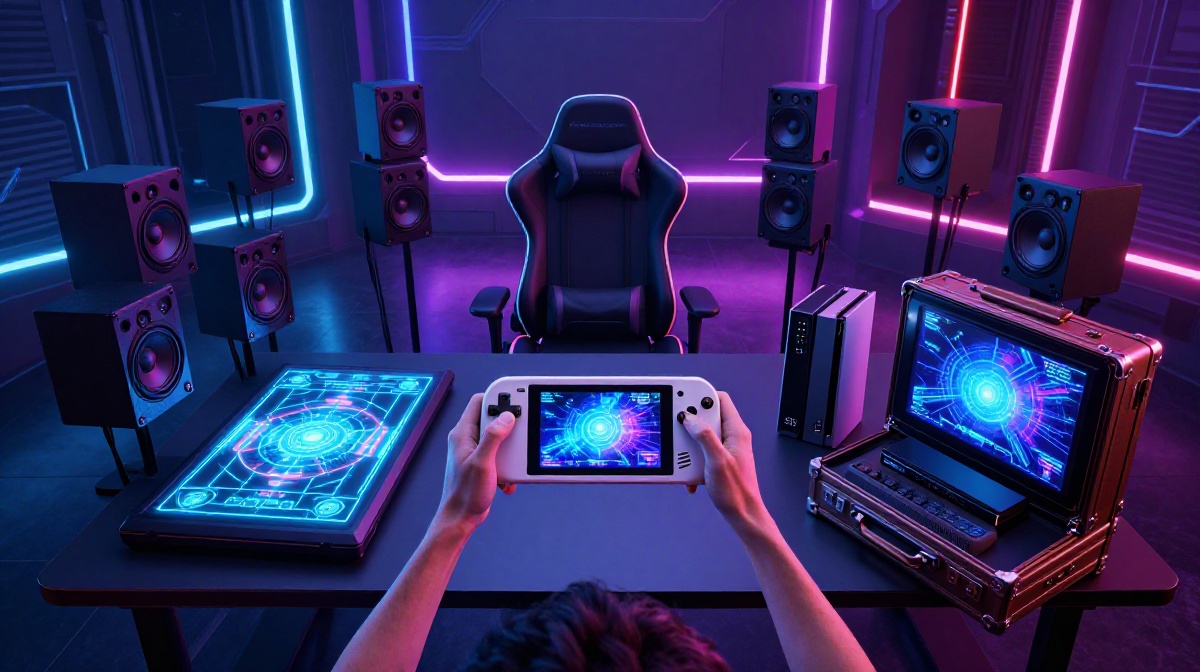
The Future of Play: Testing the Most Extreme Gaming Gadgets of 2024
In the rapidly evolving landscape of interactive entertainment, the line between “useful tool” and “expensive gimmick” is often blurred. From handhelds that emulate classic consoles at four times their original resolution to 11-speaker surround sound systems that attach to your office chair, the world of gaming hardware has never been more experimental.
This article dives deep into the most extreme gaming tech currently hitting the market, evaluating whether these gadgets are the future of the industry or simply high-priced curiosities.
1. The Transformation of Handheld Gaming: The 1X Player “Sugar One”
One of the most fascinating developments in recent years is the rise of the ultra-powerful handheld. The 1X Player “Sugar One” is presented as a “modern reimagining” of the dual-screen concept popularized by the Nintendo 3DS.
High-Resolution Nostalgia
The Sugar One distinguishes itself by its ability to emulate 3DS titles at four times the original resolution, providing a level of visual fidelity that the original hardware could never achieve. For many gamers, the 3DS remains a peak handheld experience, and seeing those games “up-resed” on a modern Android-based system feels like a generational leap.
Hardware and Tactility
The device’s build quality aims to rival industry titans like the Steam Deck or the Nintendo Switch OLED. Notable features include:
- Tactile Clicky Buttons: Unlike the mushier buttons of some older handhelds, these provide immediate physical feedback.
- Enhanced Joysticks: The sticks are described as feeling superior to any hardware Nintendo has produced, offering more precision for modern titles.
- Dual-Screen Versatility: It can function as a standard Android device or a dedicated dual-screen gaming machine, though testers noted that the moving parts might make the internal space slightly inefficient.
2. Breaking the Second Dimension: AI-Generated 3D Gaming
For years, glasses-free 3D was considered a failed experiment of the early 2010s. However, new hardware is attempting to revive the concept using Artificial Intelligence.
How it Works
Unlike the 3DS, which required games to be specifically coded for 3D, this new “behemoth” monitor uses AI to convert 2D games into 3D in real-time. It features a tracking camera that follows the user’s eyes to maintain the depth effect regardless of head movement.
The User Experience
While the effect is described as “really immersive,” it comes with significant drawbacks. Testers noted that the intensity of the AI-generated depth could lead to a migraine within minutes. There is also a sense of “gimmick fatigue”; while the execution of the technology is impressive, the practical application remains questionable for long-term gaming sessions.
3. Ergonomics and Recovery: The Gamer Hand Massager
As esports and competitive gaming become more physically demanding, hardware companies are pivoting toward gamer wellness. The “Gamer Hand Massager” is a specialized device designed to alleviate the strain caused by high-intensity actions like “jitter clicking” in Minecraft.
The Sensation of Relief
The device functions similarly to a high-end blood pressure monitor, using airbags to clamp down on individual fingersand the palm. It incorporates:
- Heat Therapy: To loosen stiff muscles in the hands and wrists.
- Specific Finger Sockets: Ensuring that every part of the hand that interacts with a mouse or keyboard is massaged.
- Pressure Points: Designed to target the back of the hand, an area frequently prone to cramping during long typing or gaming sessions.
While initially intimidating—with one tester comparing the sensation to being “murdered” or “clamped down”—the consensus was that the pressure provides a unique form of relief that cannot be replicated manually.
4. The Return of Social Gaming: “The Board”
The digital revolution has largely moved multiplayer gaming into online lobbies, often sacrificing the “couch co-op” feel of the past. “The Board” is a smart board game system designed as an “antidote” to this trend.
Digital Meets Physical
The system uses physical pieces on a digital screen that runs at a smooth 60 frames per second. The pieces are tracked by the board, allowing for immediate interaction—such as digital characters walking toward where a physical piece is placed.
Gameplay and Limitations
The experience is described as “fun for the whole family,” offering a hybrid gaming style that feels like something out of Star Wars. However, there is a notable absence of major licensed IPs like Catan or Ticket to Ride, likely due to the high cost of digital licensing. Despite this, the $400 device offers a “new gaming experience” that feels immediate and social.
5. Total Audio Immersion: The Colo GCS 11-Speaker System
If headphones feel too restrictive and standard speakers too distant, the Colo GCS offers a radical middle ground. This 11-speaker system is designed to attach permanently to a gaming chair, creating a “sound cocoon”.
A 360-Degree Soundstage
The system acts as a 360 surround sound system, mimicking the directional audio of high-end headphones without the physical discomfort of wearing them. In testing, the directional audio was so precise that users could hear virtual voices moving from one side of the chair to the other as they passed characters in-game.
The “Nightmare” Factor
Interestingly, the immersion was almost too effective for some. In horror or high-stress games, hearing “screams all around” through an 11-speaker array was described as “unnerving” and even “a nightmare”. Furthermore, for competitive players, the fidelity did not necessarily surpass high-end headphones, which many would still prefer for tracking footsteps in online shooters.
6. Mobile Gaming and Portability
The source explores several tools meant to bridge the gap between “casual” mobile gaming and “hardcore” console gaming.
Mcon O Snap Controller
This MagSafe-compatible controller “snaps” onto a smartphone, ejecting handles to create a full-sized gaming interface. It features:
- High-Quality Joysticks and Triggers: Providing a tactile feel usually reserved for consoles.
- Wireless Detachability: The controller can be detached from the phone while the phone sits on a kickstand, allowing for a more relaxed posture.
The Pocket Projector
For gaming on the go—specifically “at your grandma’s house” or in a hotel—a tiny portable projector offers a surprisingly viable solution. Roughly the size of a folding phone, it can project a gaming screen onto a ceiling, allowing players to lie flat in bed while playing titles like Super Smash Bros. Its portability and “ceiling mode” make it one of the most practical items tested.
7. The “Endgame” Portable Rig: Poger Yez OLED
Finally, for those who refuse to leave their PlayStation 5 at home, the Poger Yez OLED Edition represents the extreme end of portable gaming.
A PS5 in a Suitcase
This is essentially a hard-shell suitcase containing a PS5 Pro, a Quad HD OLED screen, and a built-in sound system. It even includes a wireless charging pad for your phone.
The Weight of Power
While it offers the ultimate “portable” console experience, its practicality is limited by its sheer size and weight. Testers noted it is the size of a long-haul suitcase, and while it has wheels, “lugging this around Heathrow airport” would be a significant chore. For most, a simple handheld portal or a HDMI cable for a hotel TV might suffice, but for “esports players,” this represents the peak of mobile performance.
Conclusion: Which Extreme Tech is Worth It?
The testing of these gadgets reveals a fascinating trend: while “extreme” tech often focuses on high specs and “wow” factors, the most successful items are those that solve a specific problem or enhance a social experience.
- The Winners: The portable projector and The Board stood out for their immediate utility and “fun factor”.
- The Niche: The 1X Player Sugar One is a masterpiece for retro enthusiasts, and the hand massager is a genuine recovery tool for high-APM (actions per minute) gamers.
- The Over-the-Top: The Colo GCS and Poger Yez OLED are impressive feats of engineering but remain “a bit much” for the average consumer.
As gaming continues to push into AI and advanced ergonomics, these gadgets serve as a preview of a future where play is more immersive, more comfortable, and—occasionally—a little bit more bizarre.

