
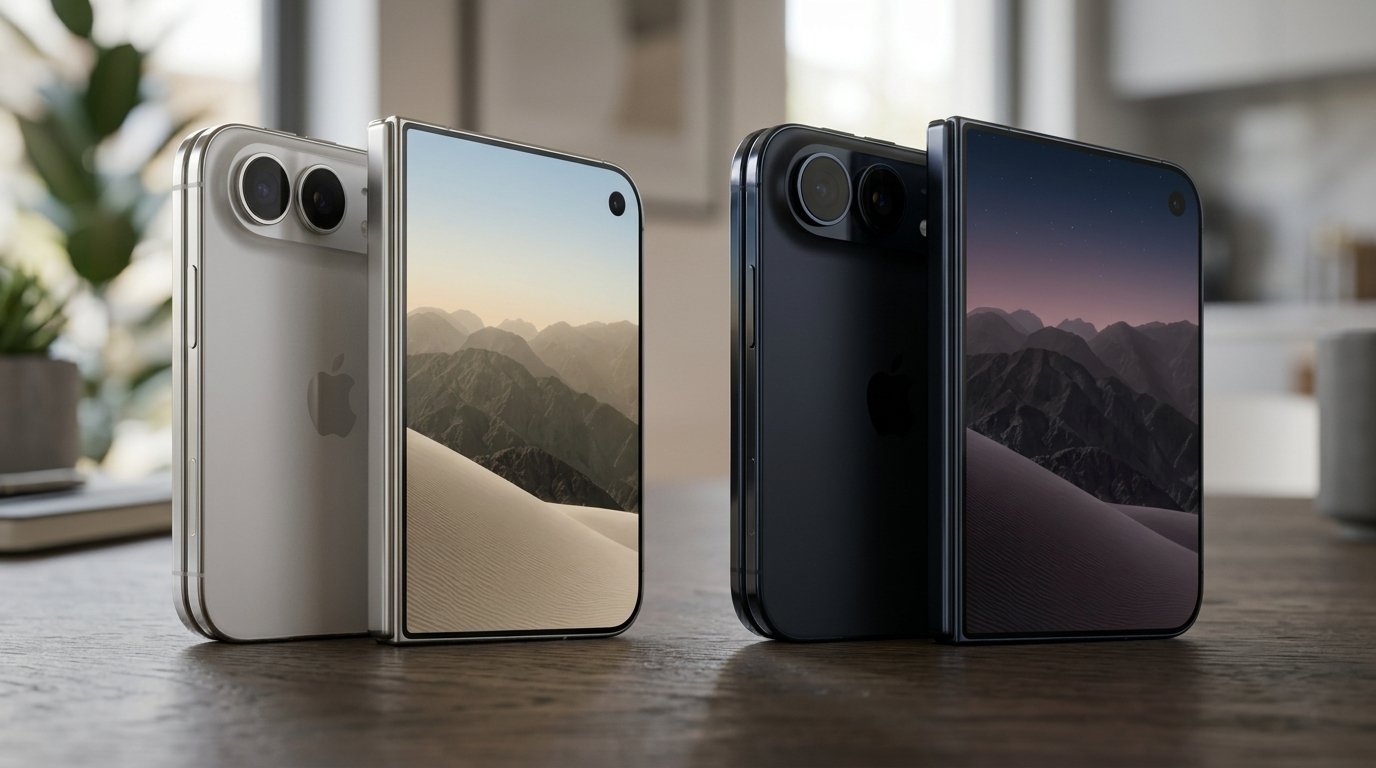
Apple Unveils iPhone 18 Pro & iPhone Duo: Specs, Variable Aperture, Folding Display, and UK Pricing
1. Introduction: Apple’s Fall Event and the Shift in Tech Strategy
Apple’s annual autumn launch event marked a structural shift in the tech giant’s smartphone release strategy. Rather than revealing its entire annual phone line-up at once, Apple adjusted its release schedule to prioritize its highest-tier hardware: the flagship iPhone 18 Pro, the iPhone 18 Pro Max, and the historic debut of Apple’s first folding handset, the iPhone Duo.
Standard consumer models—specifically the base iPhone, the new iPhone Air, and the updated iPhone SE—have been deferred to an early next year release window.
Apple Flagship Launch Schedule
- Autumn Release (October Window): iPhone 18 Pro, iPhone 18 Pro Max, and iPhone Duo (First-Generation Foldable).
- Early Next Year Release: Standard Base iPhone, iPhone Air, and iPhone SE.
Both the Pro line-up and the foldable iPhone Duo are scheduled for an October release, with pre-orders opening within a couple of weeks. The introduction of the iPhone Duo represents Apple’s first fundamental hardware form-factor departure since the original iPhone launch in 2007. With the initial Apple folding phone price established at $2,000 alongside substantial architectural upgrades across the core iPhone 18 Pro specs, this autumn launch strictly focuses on ultra-premium hardware architecture, bespoke display treatments, and advanced optical systems.
2. iPhone 18 Pro & Pro Max: Architecture, Display, and Camera Innovations
The iPhone 18 Pro and Pro Max retain the external chassis dimensions and design fundamentals of the previous generation, concentrating major upgrades within internal silicon, power optimization, display integration, and optical engineering.
2.1 Next-Gen Silicon and Battery Enhancements
Powering both Pro handsets is the new A20 Pro system-on-chip (SoC). Manufactured on a advanced 2-nanometre (2nm) process node, the architecture delivers a 50% increase in memory bandwidth over the previous generation.
While physical battery capacities remain comparable to prior models, Apple claims notable efficiency gains:
- iPhone 18 Pro: Matches the total battery endurance of the previous-generation iPhone 17 Pro Max.
- iPhone 18 Pro Max: Achieves the longest battery life ever recorded in an iPhone.
2.2 Dynamic Island Redesign & Live Activities
The physical footprint of the Dynamic Island cutout on the front display has been reduced by 25%. To achieve this, Apple relocated the Face ID infrared camera out of the central cutout, positioning it directly behind the display glass in the top-left corner.
This behind-the-display implementation results in a slightly altered pixel matrix in the upper-left display area, though it remains virtually imperceptible to the naked eye during standard usage. The resulting space saved in the primary display panel enables the interface to render up to three simultaneous Live Activities, expanding upon the two-activity limit of previous iOS versions.
2.3 Physical Variable Aperture Camera Tech
The primary wide-angle camera introduces a mechanical, physical variable aperture system. Rather than relying on software-based background blurs or digital simulation, the lens assembly incorporates motorized diaphragm blades that physically open and close to control light intake and native depth of field. The iPhone 18 Pro variable aperture represents a major leap for mobile imagery.
Manual Aperture Control Mechanics
- Stop 1 (Wide Open): Maximum light intake, creating a shallow depth of field for natural bokeh.
- Stops 2 & 3 (Intermediate): Step-down stages for variable lighting environments and group compositions.
- Stop 4 (Stopped Down): Minimum light intake, delivering deep focus across the entire scene frame.
Key technical characteristics of Apple’s implementation include:
- Four Manual Stops: Users can cycle between four discrete physical aperture stops on demand within the native camera interface.
- Mechanical Precision: The moving mechanical blades are visibly observable through the front glass element under adequate lighting.
- Comparison to Legacy Hardware: Samsung’s early implementation on the Galaxy S9 was restricted to only two fixed settings (f/1.5 and f/2.4). Apple’s system provides four stops and pairs the mechanism with a significantly larger physical image sensor, yielding a far greater visual distinction in native depth of field between wide-open and stopped-down settings.
2.4 Colour Finishes and Pricing Structure
The iPhone 18 Pro series launches in four distinct finishes:
- Burgundy: The flagship hero colour for this generation.
- Glacier: A light blue hue.
- Silver: Redesigned for visual uniformity, applying a consistent shade across both the rear glass and the metallic side frame.
- Matte Black: A fully matte, dark finish across the entire chassis.
Base pricing across the Pro lineup has increased by $100 compared to the previous generation:
- iPhone 18 Pro: Starts at $1,199
- iPhone 18 Pro Max: Starts at $1,299
Apple has also quietly increased the prices of older iPhone models still in its catalogue (such as the iPhone 16 and 17e) by $100. Note on UK Pricing: While official UK Sterling (£) pricing is awaiting final confirmation from Apple UK following the keynote, standard baseline pricing reflects the $100 generational increase across international territories.
2.5 Summary Table: iPhone 18 Pro & Pro Max Core Specifications
| Feature | iPhone 18 Pro Specs & Hardware Details |
| Processor | A20 Pro (2nm node, 50% increased memory bandwidth) |
| Display Cutout | Dynamic Island (25% smaller; Face ID IR camera under-display in top-left) |
| Live Activities | Supports up to 3 concurrent Live Activity widgets |
| Main Camera System | Physical variable aperture mechanism with 4 distinct mechanical stops |
| Battery Claims | 18 Pro: Matches 17 Pro Max lifespan<br>18 Pro Max: Longest battery life ever in an iPhone |
| Chassis Finishes | Burgundy, Glacier (Light Blue), Uniform Silver, Fully Matte Black |
| Base Price | 18 Pro: $1,199<br>18 Pro Max: $1,299 |
3. iPhone Duo Deep Dive: Apple’s First Passport-Style Foldable
The iPhone Duo represents Apple’s initial entry into the foldable hardware segment. Designed as a passport-shaped, book-style device, it functions as a compact smartphone when closed and expands into a tablet-style workspace when unfolded. Early hands-on evaluation in this initial iPhone Duo review highlights its specific structural, software, and mechanical characteristics.
3.1 Hardware, Displays, and Crease Reduction
- Outer Display: Features a 5.4-inch high refresh rate panel with a top-corner hole-punch camera cutout. The external screen uses an asymmetrical “D-shape” geometry, featuring a squared-off left edge along the hinge and a rounded rail on the right edge.
- Inner Display: Opens to a 7.6-inch high refresh rate display with uniform borders. The inner screen is layered with a specialized nano-texture matte anti-glare coating. This surface treatment diffuses harsh environmental light reflections and aids in obscuring the central crease.
- Inner Selfie Camera Placement: To maintain an uninterrupted canvas, Apple embedded the inner selfie camera behind active display pixels, located specifically in the middle of the right-hand side of the 7.6-inch screen.
- Hinge Engineering & Crease: The internal hinge utilizes carbon-fibre support plates paired with a stiff top layer of ultra-thin glass. Visual crease suppression is notable, performing on par with leading minimal-crease foldables such as the Oppo Find N6.
- Chassis Ergonomics: Constructed with a titanium frame and rounded side rails. Biometric authentication relies on a Touch ID fingerprint reader embedded directly into the right-hand power button (Face ID is omitted on the Duo).
- Physical Controls & Audio: Volume buttons are positioned along the top rail rather than the side, ensuring directional consistency regardless of device orientation (right increases volume, left decreases). Split stereo speakers are positioned on the top-front rail and bottom-back rail to preserve true left/right channel separation in open modes.
- Durability & Stylus Support: The unit carries a robust IP68 dust and water resistance rating, includes full MagSafe array integration, and is scheduled to support the USB-C Apple Pencil across both internal and external screens via a software update arriving later this year.
3.2 Software Experience: “iOS with Extra Sauce”
The software environment combines core iOS mechanics with selective iPadOS multitasking capabilities:
- Display Continuity: Switching between the outer and inner screens activates a smooth, progressive fade animation with zero display wake latency upon opening or closing.
- Right-Hand Reachability Weighting: System interface elements are weighted toward the right rail for one-handed accessibility. This includes a dedicated vertical Application Dock restricted to the right edge of the interface. The dock accommodates a maximum of four app icons and cannot be repositioned to the left side.
- Unified Home Screens: Outer and inner display layouts are directly mirrored; adding or modifying pages on one layout automatically updates the corresponding screen layout.
- Multitasking & Gestures: Unfolded applications load natively as multi-column iPad layouts. Users can run two applications side-by-side via dedicated touch gestures.
- Tent / Standby Mode: Locking the device while positioned half-open in a “tent” stance activates Standby mode, transforming the handset into a bedside clock that displays time and alarm alerts with a soft background glow.
iPhone Duo Operational Display Modes
- Closed Mode (5.4-inch External Screen): Compact passport aspect ratio, right-weighted UI with 4-icon side dock, and direct Touch ID access via the power button.
- Unfolded Mode (7.6-inch Internal Screen): Nano-texture matte anti-glare finish, corner-to-corner view via the under-display camera, multi-column iPad apps, and side-by-side multitasking.
- Tent / Standby Mode (Half-Open Stance): Angled desktop display operating as a low-power nightstand clock and alarm interface with a gentle glow.
3.3 Internal Specs, Cellular Tech, and Global Market Context
The iPhone Duo is powered by the A20 Pro chip alongside Apple’s proprietary C2 cellular modem, which delivers upgraded data throughput and native 5G millimetre-wave (mmWave) connectivity. The rear camera module consists of a dual-lens array: a 48-megapixel primary camera and the same ultrawide camera used on the iPhone 18 Pro.
Apple’s introduction of a foldable device directly addresses key global market trends—most notably in China, where consumer consumption of foldable smartphones last year surpassed the total volume of all other international markets combined.
4. iPhone Duo vs. Samsung Galaxy Z Fold 8: Comparison & Trade-offs
The iPhone Duo enters direct competition with Samsung’s established foldable flagships, most notably the Galaxy Z Fold 8.
4.1 Comparative Feature Breakdown
| Feature / Specification | Apple iPhone Duo | Samsung Galaxy Z Fold 8 |
| Form Factor / Style | Passport-style book fold (Asymmetrical “D-shape” exterior) | Passport-style book fold |
| Entry Price Point | $2,000 | $1,800 |
| Biometric Authentication | Touch ID fingerprint sensor (Power button) | Fingerprint sensor (Power button) |
| Ingress Protection | Rated IP68 (Full dust & water submersibility) | Standard water resistance rating (No IP68 rating specified) |
| Rear Camera Hardware | Dual Camera Array (48MP Primary + Ultrawide) | Dual Camera Array (Main + Ultrawide) |
| Inner Selfie Camera | Under-display camera (Middle of right side) | Standard Hole-punch cutout |
| Screen Transition Speed | Instant wake, progressive fade, zero delay | Standard folding display activation delay |
4.2 Where iPhone Duo Wins (“The Fit and Finish”)
- Instant Screen Activation: Eliminates the wake-up latency common in foldables when toggling between closed and unfolded states.
- Reflection & Crease Control: The nano-texture matte layer diffuses direct glare and conceals the display crease more effectively than glossy plastic or glass coatings.
- IP68 Ingress Protection: Achieves full IP68 dust and water resistance, an engineering standard rarely achieved in folding hardware.
- Hinge Calibration: The spring tension of the carbon-fibre supported hinge allows precise positioning at custom angles without snapping closed or springing fully open.
4.3 Key Compromises and Downsides of the iPhone Duo
- Under-Display Selfie Camera Quality: To keep the internal 7.6-inch display borderless, Apple embedded the inner selfie camera behind active pixels in the middle of the right-hand side of the screen. This camera produces noticeably soft, degraded video quality with visible grain, echoing the image degradation issues that previously led Samsung to abandon under-display cameras in favour of standard hole-punch cutouts.
- Asymmetrical External Bezel: The cover screen’s flat hinge edge on the left and curved border on the right creates a distinct visual asymmetry.
- Rigid Interface Constraints: The vertical dock is hard-coded to the right edge of the screen, cannot be relocated for left-handed use, and strictly limits users to a maximum of four app shortcuts.
- Missing Flagship Hardware Features: The device lacks a dedicated telephoto/zoom lens, omits high-density silicon-carbon battery chemistry, and does not support ultra-fast wired charging standard on competing high-end foldables.
5. Pricing, Availability, and Final Verdict
Complete Lineup Price Summary
- iPhone 18 Pro: Starts at $1,199
- iPhone 18 Pro Max: Starts at $1,299
- iPhone Duo: Starts at $2,000
The official Apple folding phone price places the iPhone Duo at the apex of Apple’s handheld product catalogue. While an entry point of two thousand dollars represents a steep premium tier ($200 higher than the Galaxy Z Fold 8’s $1,800 starting point), it sits lower than many analysts anticipated given the inclusion of the 2nm A20 Pro SoC, the C2 5G mmWave modem, custom nano-texture optics, and titanium construction.
For UK consumers, while official Sterling (£) figures will be finalised at regional checkout following the keynote announcement, baseline global figures confirm the high-end positioning.
Autumn Flagship Release Matrix
| Device | Base Price (US Baseline) | Key Highlight |
| iPhone 18 Pro | $1,199 | 4-Stop Mechanical Variable Aperture |
| iPhone 18 Pro Max | $1,299 | Longest Battery Life Ever in an iPhone |
| iPhone Duo | $2,000 | 7.6″ Matte Foldable Display with IP68 Rating |
Launch Schedule
- Pre-Orders: Opening within two weeks of the announcement event.
- Retail Availability: Full commercial release scheduled within the October availability window.
Final Verdict
Apple’s annual launch split allows the iPhone 18 Pro series to refine essential core technologies—highlighted by true mechanical depth control via its physical variable aperture lens and enhanced battery endurance. Simultaneously, the iPhone Duo establishes Apple’s presence in the growing foldable market.
Initial evaluation in this iPhone Duo review indicates that while the first-generation foldable makes clear trade-offs in inner camera clarity, external symmetry, and camera zoom flexibility, its structural rigidity, IP68 water resistance, anti-glare display engineering, and rapid software continuity deliver a remarkably polished entry into the foldable landscape.

